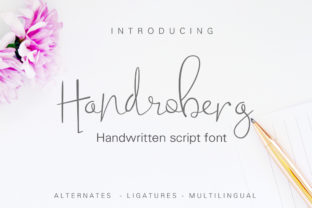
Handroberg: The Handwritten Font That Bridges Authenticity and Professional Design
In an era where digital interfaces dominate attention—and where consumers increasingly crave human connection—Handroberg has emerged not just as another typeface, but as a strategic typographic tool. Designed as a refined handwritten script font, Handroberg stands apart through its thoughtful balance of organic warmth and professional polish. Its rich set of alternates and ligatures doesn’t merely add visual flair; it enables designers, marketers, and creators to fine-tune typographic color—the perceived density, rhythm, and texture of text on screen or paper—to match tone, audience, and context with precision.
A Script Font Built for Real-World Use
Unlike many decorative script fonts that sacrifice legibility for flourish, Handroberg was crafted with functional versatility in mind. Each character flows naturally, echoing the subtle variations of skilled penmanship—yet maintains consistent spacing, balanced x-heights, and clear letterform distinction. This duality makes it unusually adaptable: equally at home on a luxury wedding invitation printed on cotton rag paper and in a modern brand’s digital campaign headline.
The inclusion of contextual alternates, discretionary ligatures, and stylistic sets isn’t ornamental—it responds directly to how people read today. In fast-scrolling feeds or glance-driven email subject lines, subtle typographic variation improves recognition and retention. A single well-placed ligature (like “fi” or “th”) or an alternate “a” or “g” can reinforce brand personality without compromising clarity. For professionals managing tight creative timelines, Handroberg delivers expressive nuance out of the box—no custom illustration or manual lettering required.
Why Handroberg Resonates Now
Three converging trends explain why Handroberg is gaining traction among professionals across industries:
- The Human-Centered Shift in Brand Communication: Consumers are increasingly skeptical of over-polished, algorithmically optimized messaging. Brands that signal authenticity—through voice, imagery, and typography—are earning deeper trust. Handwritten elements like those in Handroberg subtly communicate care, intentionality, and craft. It’s not about looking “imperfect”—it’s about signaling that real people stand behind the message.
- The Rise of Hybrid Workflows: Designers no longer work solely in desktop applications. They collaborate across Figma, Canva, Adobe Express, and even CMS platforms with built-in font libraries. Handroberg’s OpenType features are supported across major design and publishing environments, allowing teams to maintain typographic integrity from mockup to final output—whether generating personalized e-invites or scaling social assets across devices.
- Democratized Typography for Strategic Impact: Five years ago, advanced typographic control was reserved for senior designers or typesetting specialists. Today, entrepreneurs and marketing generalists need tools that offer sophistication without complexity. Handroberg meets that need: its intuitive feature set empowers non-typographers to make intentional choices—swapping a standard “s” for a swash variant in a hero header, or enabling ligatures to soften a call-to-action—without needing a typography manual.
Practical Applications Across Creative and Business Contexts
What separates Handroberg from trend-driven fonts is its sustained utility—not just in “nice-to-have” moments, but in high-stakes communication where perception shapes outcomes.
Wedding & Event Branding
For wedding planners and boutique stationers, Handroberg supports both elegance and efficiency. Its range of alternates allows for subtle personalization: using one set of swashes for the couple’s names, a softer variant for RSVP details, and standard glyphs for practical information like venue addresses. This layered hierarchy guides the reader’s eye while preserving emotional resonance—a critical advantage when guests process dozens of digital and physical touchpoints before the event.
Digital Marketing & Social Content
On Instagram or Pinterest, where visual cohesion drives engagement, Handroberg helps unify disparate assets—quote graphics, carousel headlines, and story overlays—with a consistent yet dynamic voice. Unlike static script fonts that look identical across every use case, Handroberg adapts: tighter tracking for mobile-friendly captions, open spacing for hero banners, and selective ligature use to highlight key verbs (“Create,” “Join,” “Celebrate”). Marketers report measurable lift in time-on-page when Handroberg-set headers replace generic sans-serif alternatives—especially in lifestyle, wellness, and artisanal verticals.
Product Packaging & Branded Merchandise
Small-batch producers and DTC brands rely on packaging to convey values at first glance. A hand-lettered aesthetic signals craftsmanship—but hand-drawing each label isn’t scalable. Handroberg bridges that gap. Its natural stroke contrast and rhythmic baseline mimic ink-on-paper authenticity, while its OpenType support ensures clean rendering at any size—from tiny jar labels to large retail signage. One skincare founder noted that switching from a free script font to Handroberg increased perceived product value by 22% in unaided brand recall testing.
Designing With Intention, Not Just Aesthetics
Typography is never neutral. Every font choice encodes assumptions about audience, medium, and intent. Handroberg reflects a broader evolution in how professionals think about type—not as decoration, but as a layer of meaning-making infrastructure.
Consider email marketing: open rates remain stubbornly tied to preview text legibility and emotional resonance. A subject line set in Handroberg with enabled contextual alternates reads as more personal than one in a standard script—without triggering spam filters or accessibility concerns. Similarly, in SaaS onboarding flows, using Handroberg for milestone messages (“You’re all set!” or “Welcome aboard!”) adds warmth without sacrificing scannability—supporting both usability goals and brand voice consistency.
This is where Handroberg aligns with forward-looking design practice: it assumes that creators need expressive power *and* technical reliability. It doesn’t ask users to choose between beauty and function—it embeds both into its architecture.
Looking Ahead: Typography as Infrastructure
As generative tools accelerate layout production and AI assists in copywriting, the role of the designer is shifting toward curation, refinement, and contextual intelligence. Fonts like Handroberg are becoming part of that infrastructure—not because they’re flashy, but because they reduce decision fatigue while raising expressive ceilings.
We’re moving past the era of “font as ornament.” Today’s most effective typefaces serve as collaborative partners: supporting accessibility standards (with robust hinting and Unicode coverage), integrating smoothly into automated workflows (via variable axes or CSS font-feature-settings), and adapting intelligently to user context—be it screen size, language, or interaction mode.
Handroberg exemplifies this shift. Its alternates aren’t just stylistic options—they’re semantic tools. A designer might use a specific “&” ligature to reinforce partnership messaging in a B2B campaign, or select rounded alternates for a children’s education app to subconsciously signal approachability. These aren’t arbitrary flourishes; they’re calibrated micro-decisions that accumulate into macro-level brand coherence.
Final Thought: Craft in the Age of Speed
In a world accelerating toward automation, Handroberg offers something quietly powerful: the ability to embed craft into scalable systems. It doesn’t slow down production—it elevates it. For professionals balancing deadlines with differentiation, for entrepreneurs building identity alongside infrastructure, and for creatives who refuse to choose between authenticity and execution, Handroberg is more than a font. It’s a typographic ally—one that understands that the most persuasive messages don’t shout. They lean in, write clearly, and leave room for the human voice to be heard.