Cindyland: A Handwritten Font That Brings Warmth, Personality, and Clarity to Your Designs
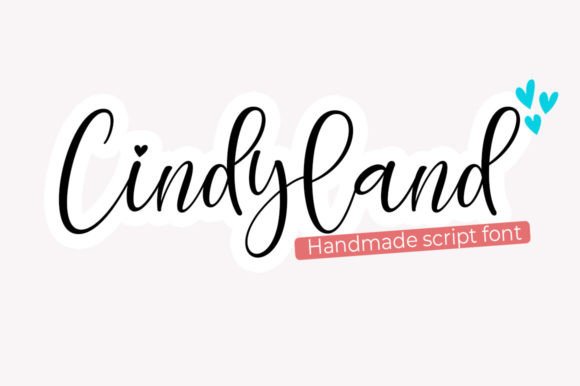
When you're designing a logo, crafting an invitation, or building a brand identity that feels human and heartfelt, the right font does more than convey words—it conveys tone, trust, and intention. Cindyland is a sweet and friendly handwritten font designed with natural flow and expressive charm. Its gentle curves, subtle inconsistencies, and warm rhythm mimic authentic pen-on-paper writing—without looking overly casual or childish. It’s not just decorative; it’s purpose-built for connection.
Many designers and small business owners face a quiet but persistent challenge: how to stand out in a sea of polished, algorithm-optimized, and often impersonal visuals—especially online. Consumers today respond strongly to authenticity. Yet “authentic” doesn’t mean unrefined. It means intentional, relatable, and emotionally resonant. That’s where Cindyland steps in—not as a trend-chasing novelty, but as a thoughtful tool for human-centered design.
What Makes Cindyland Different From Other Handwritten Fonts?
Not all handwritten fonts are created equal. Some feel stiff or overly scripted. Others lean too far into whimsy, limiting their versatility across professional contexts. Cindyland strikes a rare balance: it’s soft enough for a baby shower invitation, yet confident enough for a boutique skincare brand’s packaging or a therapist’s website headline. Its uniqueness lies in its organic imperfection—slight variations in stroke weight, natural entry and exit strokes, and a rhythm that breathes rather than repeats.
This isn’t a font generated from vector templates or automated calligraphy algorithms. Cindyland was crafted by hand and carefully digitized to preserve its warmth and nuance. As a result, it scales beautifully across sizes and mediums—from social media banners to printed stationery—without losing its personality.
Situations Where Cindyland Delivers Real Value
Here are common scenarios where users benefit most from choosing Cindyland, along with practical outcomes:
- Small business branding: A local bakery, florist, or handmade goods shop needs visual language that feels personal and inviting. Using Cindyland in logos, signage, or product labels helps communicate care and craftsmanship—reinforcing what customers already value about small-scale, community-based services.
- Wellness and creative professionals: Therapists, life coaches, yoga instructors, and artists often seek fonts that reflect empathy and openness. Cindyland supports that message without sacrificing readability or professionalism—especially when paired with clean sans-serif body text.
- Personalized printables and digital products: From wedding stationery to printable planners or downloadable art, Cindyland adds emotional resonance. Its legibility at smaller sizes (down to 14–16px) makes it viable for body copy in well-designed layouts—not just headlines.
- E-commerce product storytelling: On product pages, short descriptive phrases in Cindyland (“Hand-poured with love”, “Made just for you”, “Freshly harvested”) subtly reinforce brand voice and build trust faster than generic typography ever could.
How to Use Cindyland Effectively—Without Overdoing It
Like any expressive font, Cindyland shines brightest when used with restraint and intention. Here’s how experienced designers and non-designers alike get the most from it:
- Lead with clarity: Use Cindyland for headings, quotes, or short calls-to-action—not long paragraphs. Pair it with a highly legible, neutral typeface (like Inter, Lato, or Open Sans) for body text. This contrast creates visual hierarchy while keeping content accessible.
- Test color and background contrast: Because of its fine details and organic strokes, Cindyland performs best on light backgrounds with high-contrast colors (e.g., charcoal gray or deep navy on off-white). Avoid very light grays or busy textured backgrounds unless you’ve tested readability at multiple screen sizes.
- Consider your audience’s expectations: A financial advisor targeting retirees may find Cindyland better suited for a newsletter signature than a homepage headline—where credibility and clarity take priority. Meanwhile, a children’s book illustrator would likely use it across titles, chapter headings, and even speech bubbles with excellent effect.
- Leverage OpenType features if available: Some versions of Cindyland include alternate characters and ligatures. These subtle variations add richness to repeated words (like “love” or “forever”) and prevent visual fatigue in longer headline treatments.
Who Benefits Most—and How Their Needs Shape Usage
Different users approach Cindyland with distinct goals—and that shapes how they implement it:
- Non-designers (entrepreneurs, educators, content creators): They often need fast, reliable solutions. For them, Cindyland works best in pre-designed Canva templates or simple WordPress themes where it’s applied consistently to headers and accent text. The key is consistency—not complexity.
- Graphic designers and brand strategists: They explore Cindyland as part of a broader typographic system. They’ll test kerning adjustments, experiment with letter-spacing for impact, and integrate it thoughtfully into style guides alongside color palettes and imagery direction.
- Print specialists and packaging designers: They appreciate how Cindyland holds up in foil stamping, embossing, or letterpress. Its moderate x-height and open counters ensure crisp reproduction—even at small sizes on product tags or ingredient lists.
Practical Tips Before You Download or License Cindyland
Before integrating Cindyland into your project, consider these real-world factors:
- Licensing scope: Check whether your intended use (e.g., client work, merchandise, web embedding) is covered under the license. Many reputable vendors offer clear, tiered options—including desktop, web, and extended commercial licenses.
- File format compatibility: Ensure the version you choose includes OTF or TTF files for desktop use, and WOFF/WOFF2 if you plan to serve it on websites. Self-hosting gives you full control over loading performance and privacy compliance.
- Language support: Standard Cindyland covers Latin-based languages (including accented characters used in French, Spanish, and German). If you serve multilingual audiences, verify coverage for diacritics and special glyphs before finalizing.
- Accessibility note: While Cindyland is highly legible for most readers, avoid using it for critical UI elements like form labels or error messages. Reserve it for expressive, non-essential text where personality enhances—not replaces—functionality.
In a digital landscape increasingly shaped by automation and uniformity, Cindyland offers something quietly powerful: the reassurance of human presence. It doesn’t shout—but it invites. It doesn’t dominate—but it lingers. Whether you’re launching a new service, refreshing a brand voice, or simply trying to make your next project feel more like you, Cindyland is more than a font. It’s a thoughtful choice—one that says, “I made this with care.” And in today’s world, that kind of intention matters more than ever.